


OddsHub Review 2026: The Honest Truth About This Sharp Odds Tool
If you’ve been matched betting for a while, you’ll know the feeling.
The sign-up offers are done. Half your accounts are gubbed. The reloads are getting thinner every week.
So what’s next?
For a lot of people, the answer is value betting: taking prices from the bookies that are simply wrong, and letting the maths do the rest over time.
That’s exactly the space OddsHub plays in, and it’s been getting a lot of attention lately.
As always with Beating Betting, you’ll find zero bullsh** in this OddsHub review.
We’ll tell you what it does well, where it falls down, and most importantly, whether it’s actually worth your money as a UK bettor.
Please note:
A lot of the OddsHub reviews floating around right now are written for American sports bettors. Some of them even contradict each other on basic things like pricing.
This review is written for UK bettors, and particularly for anyone coming from a matched betting background.
Exclusive Beating Betting offer: use code OLLIE20OFF to get 20% off any paid OddsHub plan when you sign up through this link.
General Overview of OddsHub
OddsHub is an odds platform built around one simple idea:
When a sharp bookmaker moves its price, the soft bookies are often slow to follow.
For a short window, you can still grab the old (better) price somewhere else. OddsHub is designed to spot those moves the moment they happen and show you whether there’s still value left to take.
It’s not a tipping service. It doesn’t give you picks, it doesn’t take bets and it never holds your money.
It’s a data tool. You see the price, you decide, and you place the bet at the bookie yourself.
There are really two products under the OddsHub name:
- The free odds comparison hub, which compares prices across 365+ bookmakers and 30+ sports. You don’t even need to register to use it.
- The Terminal, which is the serious bit. This is the real-time “drop feed” that tracks price moves at sharp books and pairs each one with a fair price, the bookie’s maximum stake and the best price still available.
OddsHub is run by the same team behind OddsNotifier (a separate alerts product) and odds-api.io, a paid odds data API sold to developers and businesses. More on why that matters later.
OddsHub Pricing
Here’s where things get a little confusing, because older reviews describe OddsHub as completely free.
The odds comparison hub is free. The real-time Terminal is not.
The good news for UK bettors is that OddsHub shows its pricing in pounds, so there’s no guessing at exchange rates.
Free: £0. The full Terminal, but on a 30-minute delay. Bet tracking and closing line value grading still work in real time.
Monthly pricing
Standard: £49 per month. Real-time Pinnacle drops, live charts, all sports and every main market, three drop profiles with sound alerts, one-click bet tracking and line shopping across 365+ bookies.
Pro: £99 per month. Everything in Standard, plus all seven reference books (Pinnacle, Sbobet, SingBet, 12bet, ON Sharp, FanDuel and DraftKings), player props and all markets, mobile push notifications, limit-change alerts, up to 20 drop profiles, AI analysis of your betting record and priority support.
Both monthly plans come with a 7-day free trial. You pay £0 today and you’re only charged when the trial ends, unless you cancel first.
Annual pricing (best value)
If you pay annually, you effectively get three months free:
- Standard: £37 per month, billed £441 once a year
- Pro: £74 per month, billed £891 once a year
Just be aware that the 7-day free trial only applies to monthly billing. If you want to try before you commit, start on a monthly plan.
One nice touch: OddsHub locks in the price you join at for as long as your subscription stays active, so you’re protected against future price rises.
On top of that, Beating Betting readers get 20% off any paid plan with the code OLLIE20OFF.
That brings your first month of Standard down from £49 to £39.20, and Pro from £99 to £79.20.
Sign up through this link and enter the code at checkout.
OddsHub at a glance
| Free Trial Available | Yes, 7 days on monthly plans, via this link |
| Exclusive Discount | 20% off with code OLLIE20OFF |
| Monthly Price | £49 (Standard) / £99 (Pro) |
| Annual Price | £441 (Standard) / £891 (Pro) |
| Free Plan | Yes, on a 30-minute delay |
| Bookmakers Covered | 365+ |
| Sports Covered | 30+ |
| In-Play Coverage | No, pre-match only |
| Reference (Sharp) Books | Pinnacle on Standard, seven on Pro |
| Customer Service | Priority support on Pro |
How Does OddsHub Work?
In matched betting, the oddsmatcher tells you which bet to place and the lay bet at the exchange removes the risk.
OddsHub works very differently.
There’s no lay bet. You’re backing a price because it’s better than the true odds, and accepting that some bets will lose. Over hundreds of bets, if you’ve consistently beaten the true price, the profit follows.
To work out what the “true” price is, OddsHub looks at the sharp bookmakers (mainly Pinnacle), strips out their margin, and calls what’s left the fair price.
If a soft bookie is offering more than fair, that’s a value bet.
If you’ve ever read our guide to arbitrage betting, some of this will feel familiar. The difference is that value betting doesn’t guarantee a profit on each individual bet. It relies on volume and discipline.
Tools & Features
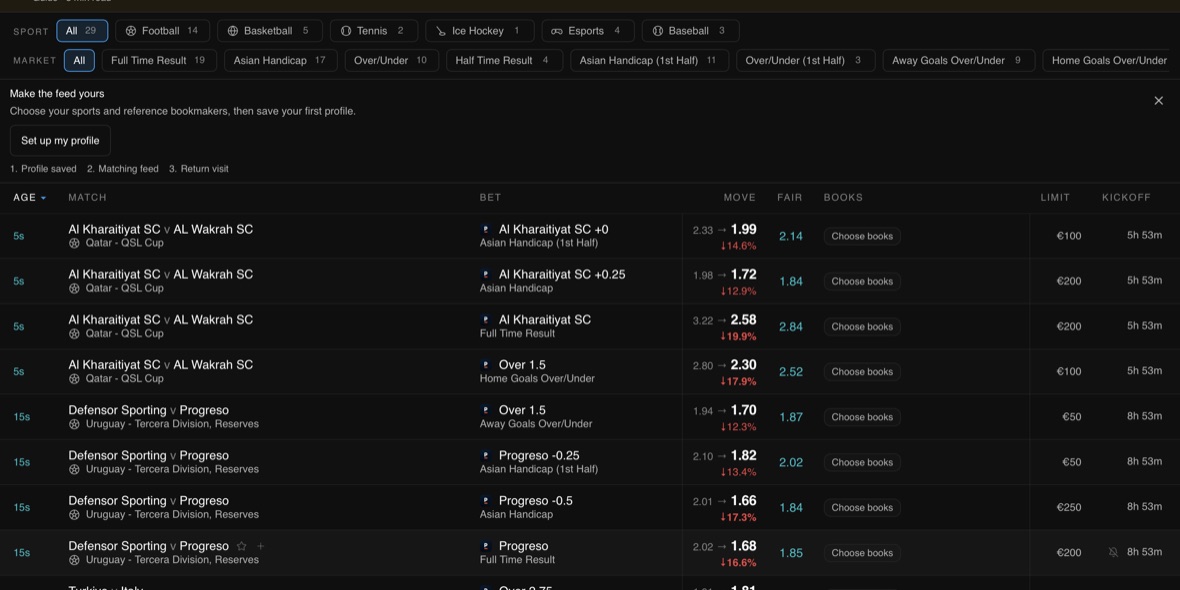
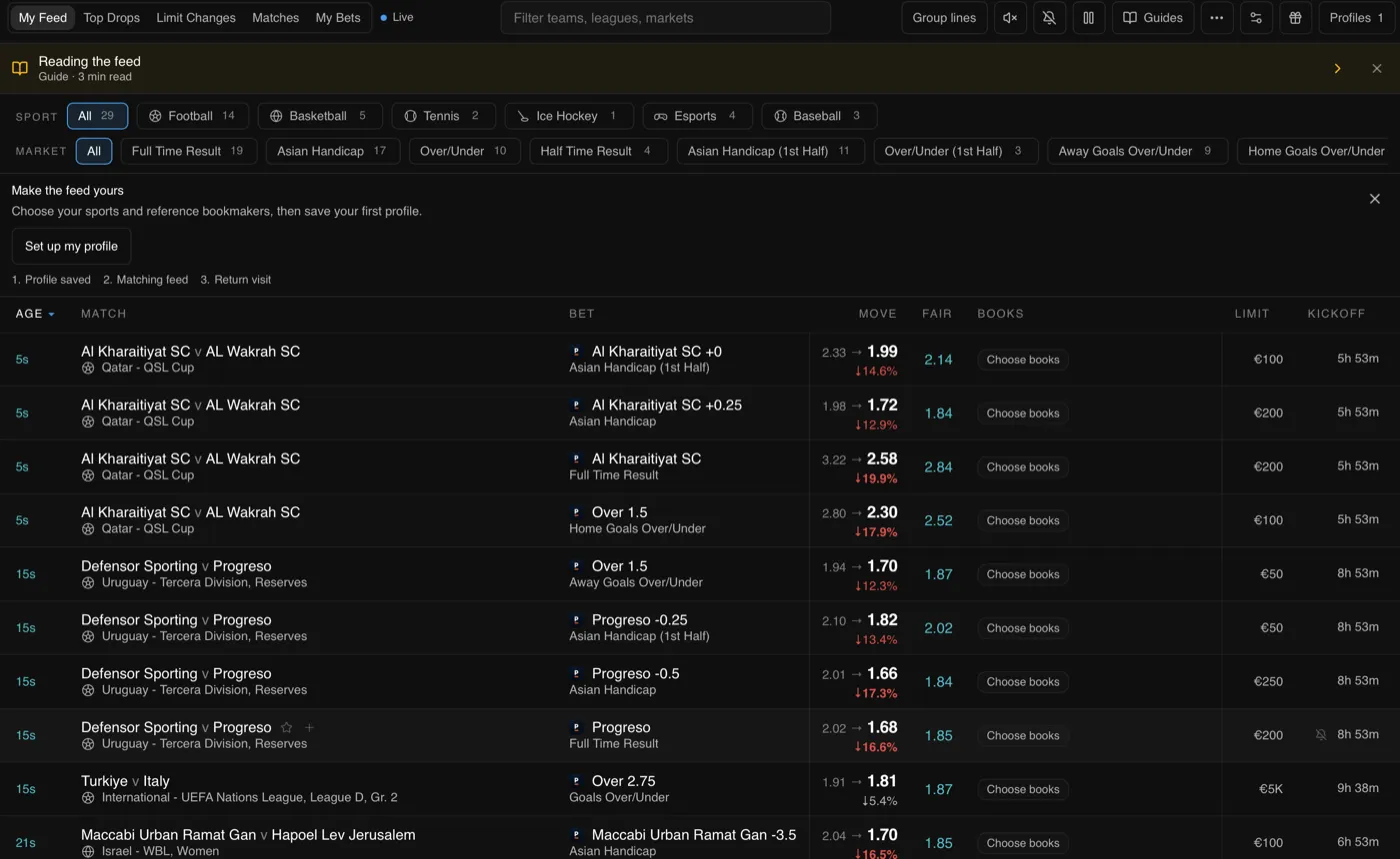
The Drop Feed (My Feed)
This is the heart of OddsHub.
Every time a sharp bookie moves a price, a new row appears in your feed. Newest first.
Each row shows you:
- How long ago the price moved
- The match and market
- How big the move was
- The fair price
- The bookie’s maximum stake (the limit)
- The best price still available at your books
If you see a “+1 more” style tag on a row, it means other markets on the same match have moved too. That usually points to genuine news (a team change, an injury) rather than one random price wobbling.
Here’s the important bit, and OddsHub is refreshingly upfront about it:
Most drops are not bets.
The feed is designed to be scanned and dismissed quickly. You’re looking for the handful of rows where value still exists.
Beats Fair vs Through Fair
This is the single most useful habit the platform teaches.
Rows get tagged Beats fair when a bookie is still offering more than the fair price. They get tagged Through fair when the market has already moved past it.
In other words, a big drop that has already gone through fair can be worth less than a small drop that hasn’t.
It sounds simple, but it stops you chasing moves that have already happened. That alone will save a lot of people money.
Limits: The Column Most People Ignore
Now this is where OddsHub gets genuinely clever.
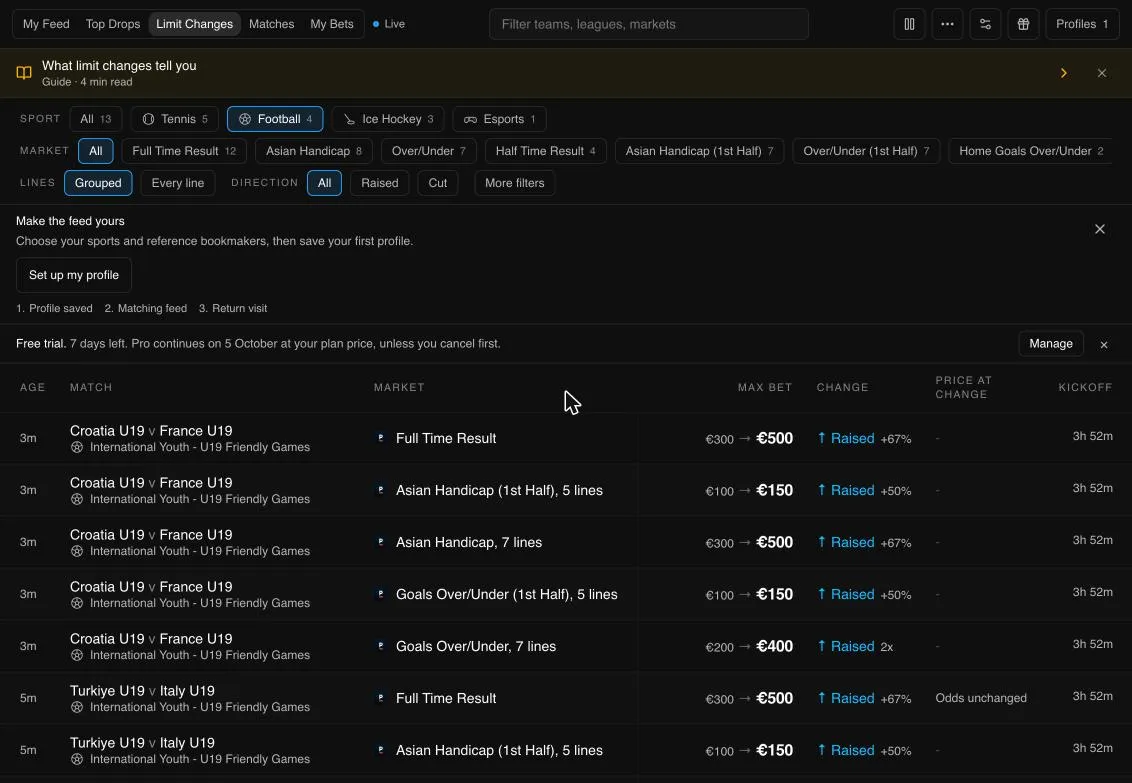
Bookies raise their maximum stakes on prices they’re confident in, and cut them on prices they’re not.
So if a price drops and the limit goes up at the same time, the bookie is essentially putting its own money behind the new number. That’s a strong signal the move is real.
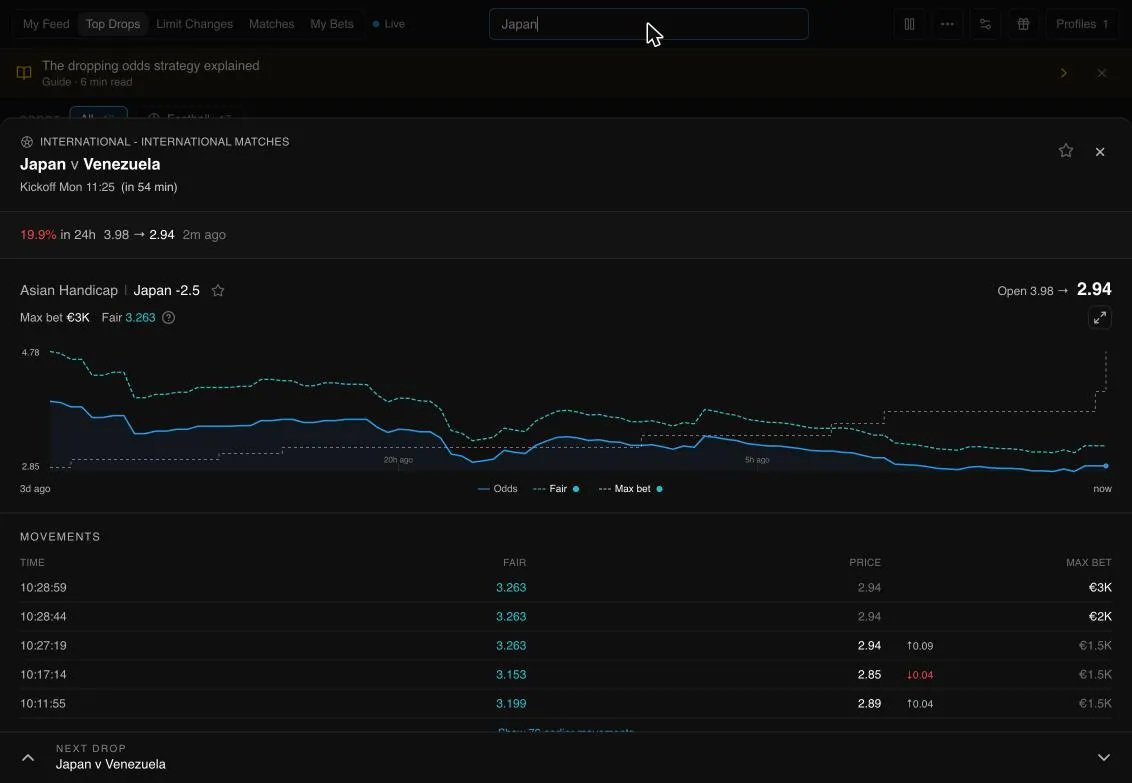
OddsHub plots price and limit on the same chart, so you can see this happening.
One example from other testers: an Aston Villa v Nottingham Forest moneyline where the away price dropped from +333 to +225 while Pinnacle’s limit jumped from €500 to €3,000.
That’s a bookie settling on a price and inviting money at it.
Here’s a real example from our own feed.
In Japan v Venezuela (international friendly, 28 September 2026), the Japan -2.5 Asian Handicap price at Pinnacle dropped from 3.96 to 3.89, a 1.8% move in just over four hours.
At the same time, Pinnacle’s maximum stake climbed from €100 to €300.
And it didn’t stop there. By the morning of the match, Pinnacle had cut the price from its opening 3.98 to 2.94 (a 26% move over three days), while its maximum stake climbed all the way from €100 to €3,000. You can see both on the chart below: the price line falling while the dashed max bet line steps up.
One honest caveat: by then the market had gone through fair. OddsHub’s fair price was 3.26 and no bookie was offering more (Bet365 was at 2.75). It’s a good example of why the Beats fair tag matters. The limit signal tells you the move is real, but you still need a price above fair to have a bet.
Two catches. First, Pinnacle is the only reference book that publishes its limits, so this signal only exists for Pinnacle prices. Second, limit-change alerts are a Pro feature.
Drop Profiles
A profile is basically a saved filter that runs constantly against the market.
Three come built in:
- Solid drops: 5% or more within an hour. The sensible one to start with.
- Steam: 3% within fifteen minutes, close to kick-off, and the limit must have moved too.
- Big movers: 8% or more from the opening price.
You can tweak minimum drop size, time window, main lines only, and a minimum maximum-stake. That last one is the most useful setting, as it filters out thin markets far better than just raising the drop percentage.
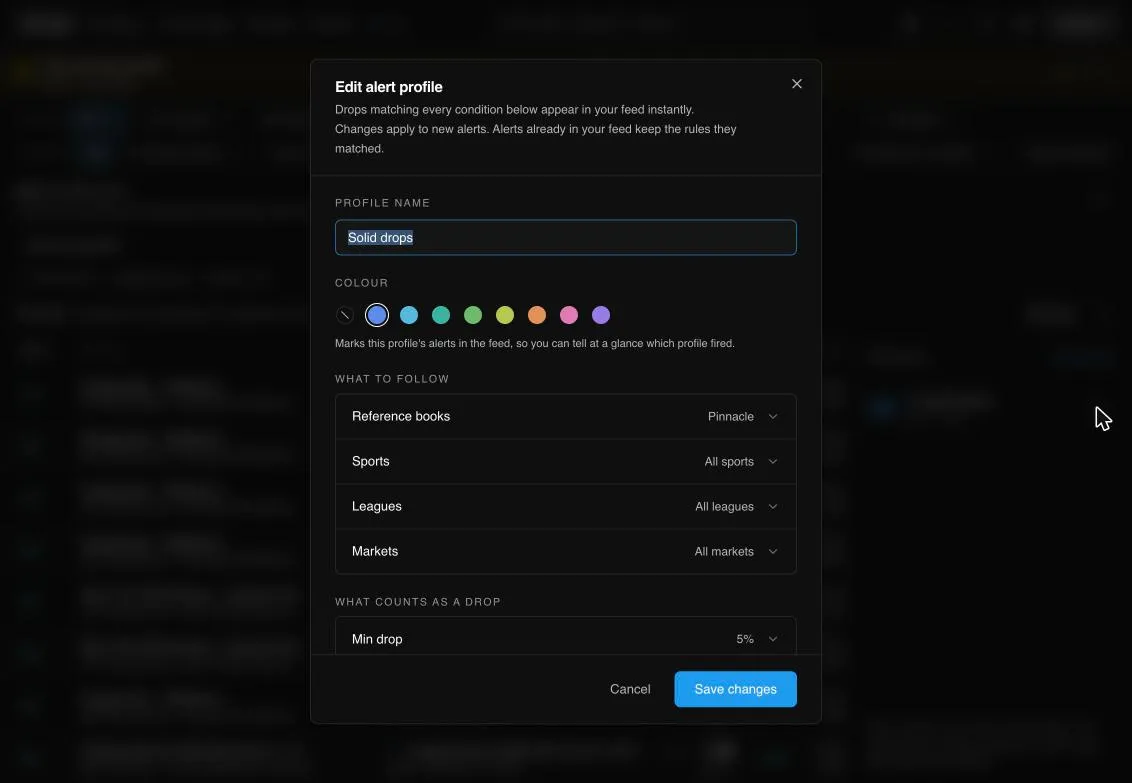
Standard gets you three profiles with sound alerts. Pro gets you up to twenty, plus push notifications to your phone.
Top tip: leave your first profile alone for an afternoon before you start fiddling with it. Over-filter on day one and you’ll end up with a profile that fires twice a week and teaches you nothing.
Value Bets
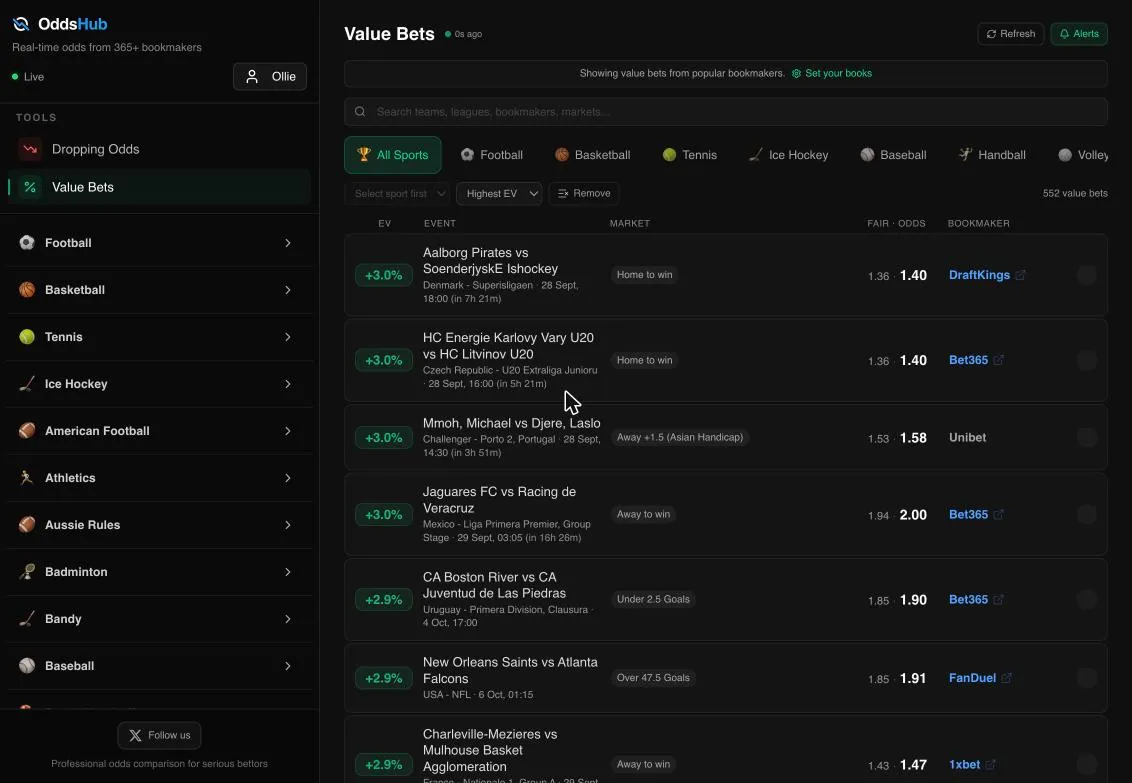
Where the drop feed shows you a price that has moved, Value Bets shows you a price that is wrong.
OddsHub takes the fair price from the sharp market and flags every bookie offering better than that. The difference is shown as your edge, as a percentage.
What separates it from a basic value bet screen is the movement analysis. Click into any bet and you get the full price and limit history, a volatility reading and the key moves since the market opened.
Bet Tracking & Closing Line Value
Many people ask us for help setting up a betting spreadsheet.
OddsHub does a lot of that for you.
Click “Track bet” and it goes into My Bets, which automatically grades your closing line value (CLV). That’s the difference between the price you took and the final price when the market closed.
If you’re consistently beating the closing price, you’re very likely a winning bettor long-term, even through a bad run of results.
The best part? CLV grading is live on every plan, including free. You can log bets from anywhere and see if you’re beating the close without paying a penny.
My Bets also splits results by profile, so you can see which of your strategies is actually working. Pro members also get AI analysis of their betting record on top.
The Free Odds Comparison Hub
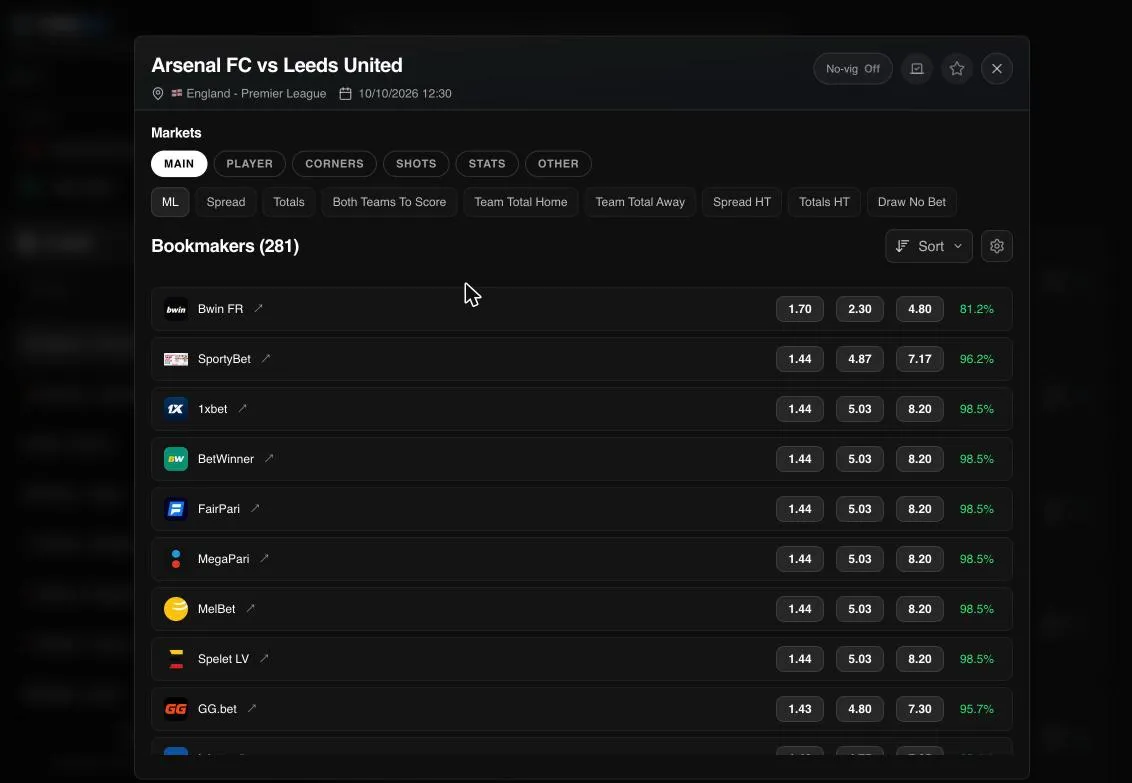
Outside the Terminal, there’s a straightforward odds comparison hub covering 365+ bookmakers, with a no-vig toggle and a payout percentage for each bookie.
It’s free, needs no account and is genuinely useful for line shopping, even if you never touch the Terminal.
Is OddsHub Any Good for Matched Bettors?
This is the question most of our readers will want answered.
Honestly? It depends where you are in your journey.
If you’re brand new, forget it for now. Start with our matched betting guide, work through the sign-up offers and build your bank first. That’s still the lowest-risk money in betting.
If you’ve finished the sign-ups and you’re comfortable with variance, OddsHub is a very sensible next step.
But here’s the reality that a lot of reviews skip over:
Bookies hate value bettors.
Take value consistently at the soft UK bookies and you will get gubbed. Probably faster than you did matched betting.
That’s why the exchanges fit this workflow so well. They make money from matching both sides of a bet, not from beating you, so winning doesn’t get your account restricted. OddsHub’s own hub lists Betfair Exchange at a 99.4% payout, which tells you how thin the margins are there.
If you’re not sure which exchange to use, check out our guide to the best betting exchange.
And if you are betting at soft bookies, mixing in some sensible mug betting will help your accounts last longer.
Where OddsHub Falls Short
We promised honesty, so here it is.
It’s pre-match only. Drops stop at kick-off, so there’s nothing here for in-play betting.
It’s built for Americans first. Player props, FanDuel and DraftKings as reference books, and a sport labelled “Football” that actually means soccer. UK bettors are clearly a secondary audience right now (although the sterling pricing is a welcome sign). Before paying, check that the bookies you actually hold are well covered.
It leans heavily on Pinnacle. Fair prices are built from it and the limit signal only works for it. Pinnacle is a brilliant source of truth, but it isn’t the sharpest book in every single market.
The plan split is steep. Limits are arguably the best thing about OddsHub, and limit-change alerts sit behind the £99 Pro plan. Standard is Pinnacle-only and main markets only.
The free plan’s 30-minute delay is too slow to bet from. Sharp moves are usually priced in well within half an hour. It’s fine for learning, not for profit. The 7-day trial is a much better test of whether the real-time feed works for you.
Top Drops ignores your profiles. It simply ranks the biggest percentage moves, which surfaces exactly the thin, unreliable markets the platform’s own guides warn you about.
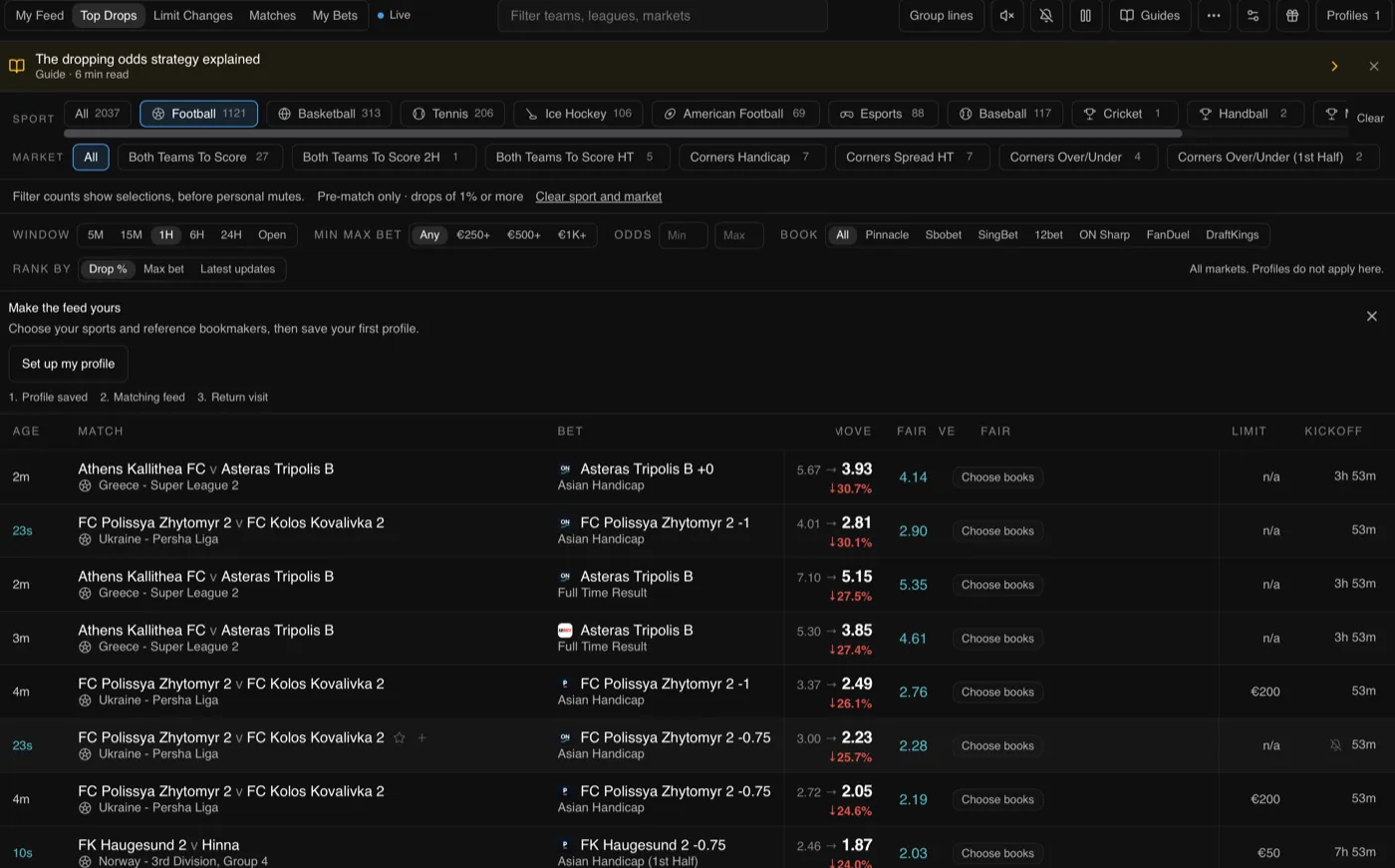
Your results depend on your books. One tester watched 30 drops across 13 events in an hour, and every single one had already gone through fair at their books. That’s not a flaw in the data, but if your bookie list is mostly gubbed, you’ll see very few bettable rows.
Is OddsHub Legit?
Yes.
OddsHub is the consumer side of odds-api.io, a paid odds data business run by the same team. They’re not reselling someone else’s feed, which goes a long way to explaining why price moves appear on screen within about a second.
They also run OddsNotifier, an established alerts product. Their pricing terms, including the price lock, are published clearly.
Education: The Surprise Highlight
We didn’t expect to be writing this section.
The in-app guides are genuinely excellent. They don’t just explain which buttons to press, they teach the thinking behind sharp betting.
The best one splits every drop into two completely different types of bet: taking a price that beats fair (where you have an edge the moment you place it), and betting that a move will continue (where you don’t, and only your CLV will tell you if you were right).
Mixing those two up is one of the most expensive mistakes a value bettor can make.
Even better, the guides actively tell you not to bet most of the time. It’s rare to see a betting tool argue against its own engagement numbers, and we respect it.
Conclusion
We give OddsHub 4 out of 5 stars.
It’s one of the most thoughtful value betting tools we’ve come across, and the way it pairs every price move with the fair price and the bookie’s limit is genuinely smart.
The free plan is excellent for learning, the 7-day trial lets you test the real thing at no cost, and live CLV tracking on every plan is a fantastic bonus for any serious bettor.
It loses a star because it’s pre-match only, it’s clearly built for US bettors first, and the best features sit behind the £99 Pro plan.
Our advice:
If you’re still working through sign-up offers, stick with matched betting for now.
If you’re a matched bettor looking for what comes next, start on the free plan and learn the guides. Once you’re comfortable, take the 7-day Standard trial and count how many rows still beat fair at bookies you actually hold. If that number is meaningful, it’s worth keeping. If it’s close to zero, your bookie list is the problem, not the tool.
When you’re ready to upgrade, use code OLLIE20OFF for 20% off any paid plan.
Try OddsHub for yourself through this link.


About the Author
This post was written by Team BB. Team BB is the collective byline for the Beating Betting editorial team. Our matched betting and sports betting guides are researched, written and kept up to date by experienced bettors, led by site owner and matched betting expert Ollie Roberts. Between us the team has made over £1,000,000 in matched betting profits since 2016.