


The Maths of Line Shopping: Why Small Odds Differences Matter Over Time
It’s not uncommon for bettors to spend considerable time researching a sports match before placing a wager, looking at injuries, team form, recent results and the odds available across different bookmakers. Comparing prices is a part of that process, but it’s easy to overlook how those seemingly tiny differences can affect potential returns.
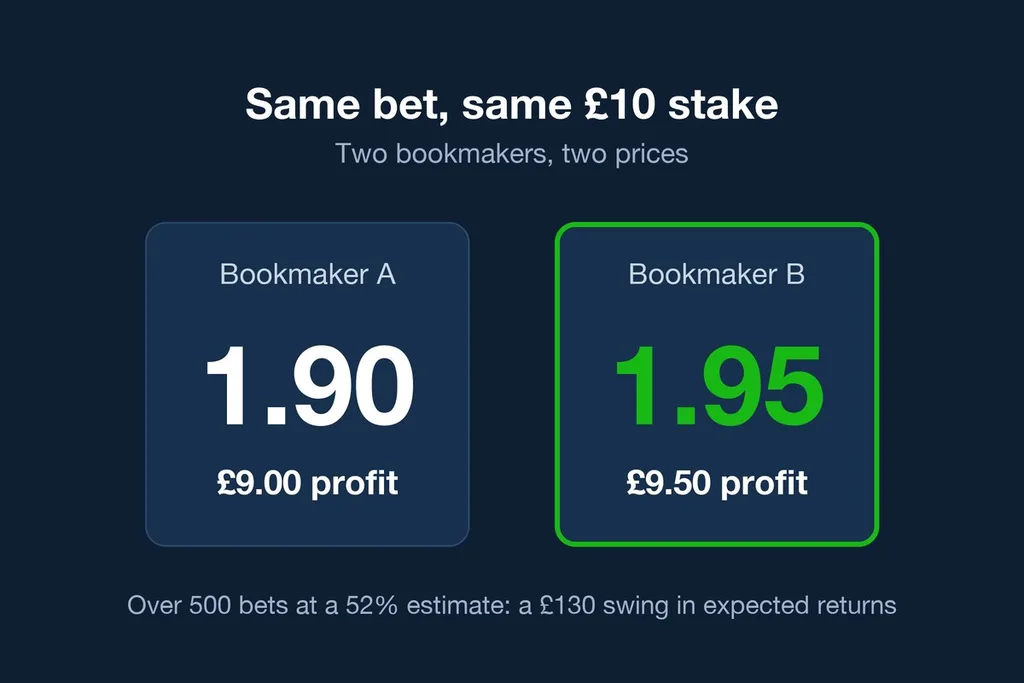
Perhaps you’ve found a selection you want to back, and you see one bookmaker offers odds of 1.90. You do your routine checks across other bookmakers, and you see the exact same outcome priced at 1.95. With a £10 stake, a win at the first price earns £9 in profit, while the second earns £9.50. If you’re already accustomed to the first platform, the extra 50p might seem insignificant, but not if you’re consistently finding better prices across hundreds of wagers.
The concept of line shopping involves comparing available odds before placing a bet to secure the best price. Although the outcome of the match will remain the same regardless of which bookmaker you choose, what changes is the potential return.
The Maths Behind Odds, Probability and Expected Profit
While winning might be a primary priority, the price you accept on a bet affects more than the amount you collect if it wins. It also changes the bet’s expected value, which measures the average profit or loss you would expect if you repeated the same wager many times under identical conditions.
To grasp how this works, you need to consider three components: the amount staked, the odds and your estimated probability of winning. The decimal odds listed determine how much you stand to win, while your probability estimate helps you work out whether the potential return justifies the stake.
The calculation goes something like this:
Expected profit = (Probability of winning × profit if successful) − (Probability of losing × stake)
Let’s say you have a football selection that you estimate has a 52% chance of winning. You decide to stake £10, which leaves a 48% chance of losing the stake.
Here’s how the expected profit changes depending on price:
At Odds of 1.90
- Potential profit: £9
- Probability of winning: 52%
- Probability of losing: 48%
- Expected profit: (0.52 × £9) − (0.48 × £10) = −£0.12
At Odds of 1.95
- Potential profit: £9.50
- Probability of winning: 52%
- Probability of losing: 48%
- Expected profit: (0.52 × £9.50) − (0.48 × £10) = £0.14
That extra 0.05 in the odds instantly shifts the expected profit from a 12p loss to a 14p gain per £10 wagered. Even past the potential winnings, comparing prices can have financial consequences, with a better price making a wager more favourable mathematically. At the same time, finding higher odds and finding value aren’t the same. Better odds improve the potential return, but they don’t make an inaccurate probability estimate more reliable or guarantee a profitable outcome.
How Comparing Odds Can Improve Long-Term Returns
The key to seeing the financial differences is to look beyond individual wagers. Seeing an expected profit of just 14p on a £10 bet might not seem particularly exciting, but across 500 wagers, that adds up to an expected profit of £70. At 1.90, the same bets would produce an expected loss of £60, leaving a £130 difference in expected returns.
The calculation isn’t a prediction, but it illustrates the financial perks of consistently securing better prices. Actual returns depend on how many selections win, and, of course, random variation can produce substantial differences between mathematical expectations and a bettor’s results. So, why do bookmakers offer different odds on the same football outcome? Each operator uses its own pricing models and takes different factors into account, including customer betting activity, preferred profit margin and market exposure. As new information becomes available and more bets are placed, prices also change. With that, one bookmaker might offer the best price on a home win, while another has more favourable odds on the draw or away win.
Getting the best price means checking what different bookmakers are offering, rather than accepting the first odds you come across. As we’ve seen, small price differences matter over hundreds of bets, as even a slight improvement in the odds can have a noticeable effect on expected returns over time. But the other factor worth considering when comparing those prices is the bookmaker’s margin. You can convert decimal odds into implied probabilities using a straightforward calculation:
Implied probability = 1 ÷ Decimal odds
For instance, 2.00 odds imply a 50% probability, and 4.00 odds imply 25%. These figures stand for the probabilities suggested by the prices. Bookmakers build a margin into their odds, which means the implied probabilities of all possible outcomes add up to more than 100%, something called the overround. In a football match, the implied probabilities of a home win, draw and away win might total 105%, with the extra 5% representing the bookmaker’s margin. Even the highest available odds aren’t necessarily good value: you still need to estimate how likely each outcome is to make that judgement.
The Limits of Line Shopping
Comparing bookmaker odds is a smart move to improve the price you get on a selection, but it doesn’t remove the uncertainties and risks that come with sports betting.
Line shopping can:
- Improve potential payouts: Higher odds mean a larger profit if the bet wins, even when the selection and stake stay the same.
- Help spot better prices: Comparing bookmakers gives you the opportunity to find more favourable odds.
- Increase expected returns: Consistently finding better prices can improve the expected value of a betting strategy over many wagers.
Line shopping cannot:
- Guarantee exact predictions: Better odds don’t make your estimate of a match outcome more accurate.
- Remove bookmaker margins: It doesn’t remove the margin built into betting markets.
- Remove the risk of loss: Even bets with positive expected value can lose, and expected returns don’t always predict actual results.
Other factors, like stake limits, price changes and settlement rules, can also affect whether you can actually place a bet at the advertised odds. However, the mathematical principle remains the same. When the stake, selection and estimated probability are unchanged, higher odds improve the expected return.
The Long-Term Value of Better Odds
It might only look like 50p at first, but why settle for 1.90 when you can get 1.95 on the exact same bet? Those extra pennies often add up across a sports season, making a real difference to your overall returns, especially for avid bettors. Better odds won’t turn every single selection into a winner, but you can at least make sure you’re getting the most out of the odds available. You can still have a losing run despite a string of sensible decisions and a good eye for favourable prices, but consistently securing better odds puts you in a stronger position in the long term.
About the Author
This post was written by Team BB. Team BB is the collective byline for the Beating Betting editorial team. Our matched betting and sports betting guides are researched, written and kept up to date by experienced bettors, led by site owner and matched betting expert Ollie Roberts. Between us the team has made over £1,000,000 in matched betting profits since 2016.